At a glance
| Area | Position |
|---|---|
| Hosting | Hosted in the EU, on redundant servers |
| Resilience | If one server fails, the other takes over automatically. |
| Separation | Each customer's data is separated by organisation and site, in the application and in the database. |
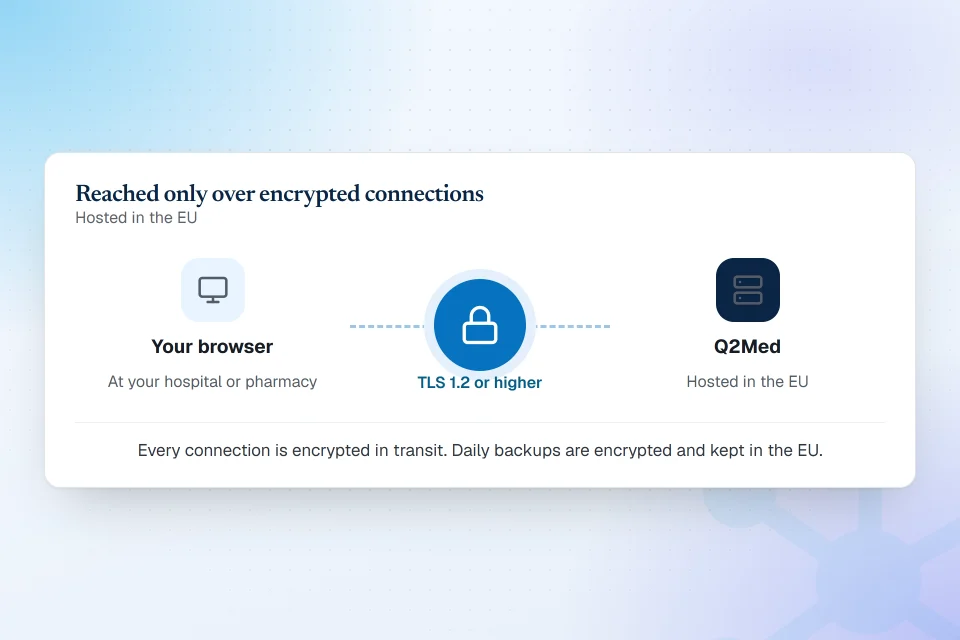
| Traffic | HTTPS only, TLS 1.2 or higher, behind a web application firewall and DDoS protection |
| Backups | Daily, off site, encrypted at rest and kept in the EU. Backups are kept for 30 days. |
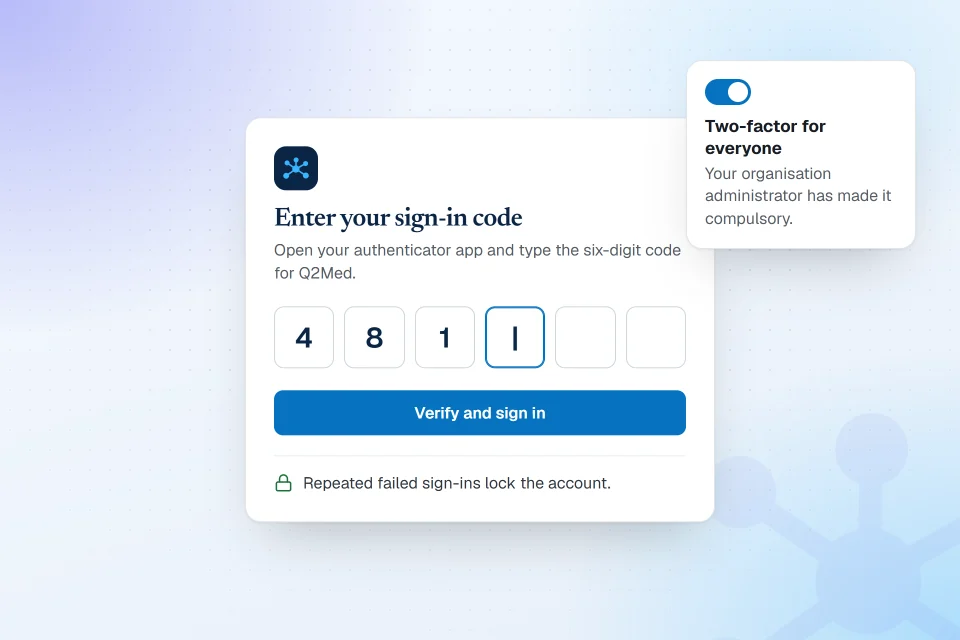
| Sign-in | Named accounts. TOTP two-factor authentication available on every account, which an organisation can enforce. Lockout after repeated failed sign-ins. Single sign-on with your hospital's Microsoft accounts as an add-on. |
| Access model | User or Organisation Administrator, scoped to organisation and site, and checked on every request. |
| Infrastructure access | Approved devices only, with multi-factor sign-in on hosting consoles |
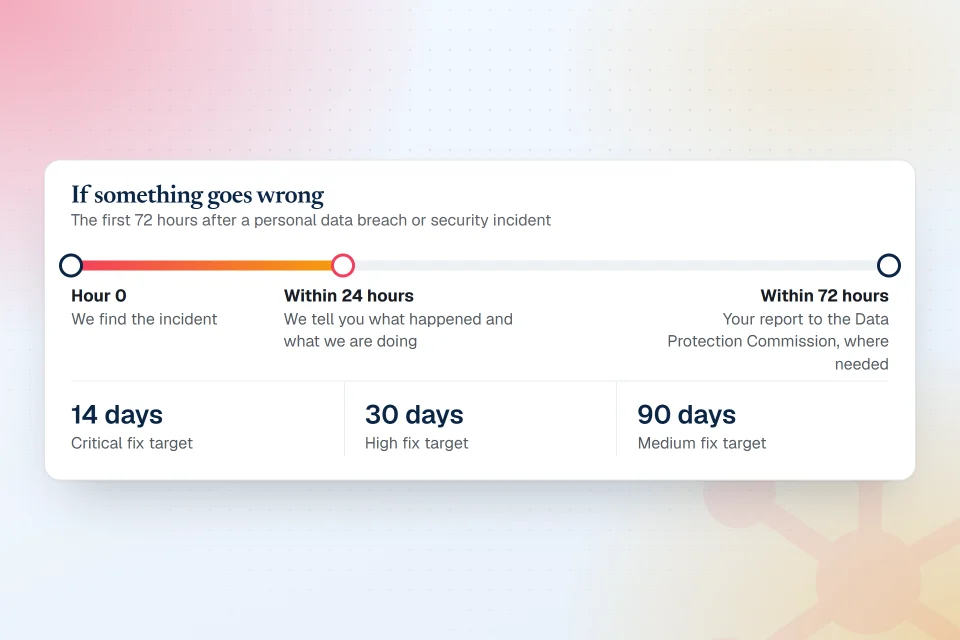
| Incident and breach notice | To the customer within 24 hours |
| Vulnerability management | Our public hostnames are scanned externally for vulnerabilities. Remediation targets: Critical 14 days, High 30 days, Medium 90 days. |
| Uptime | 99.5% SLA target, monitored by an external monitor |
| Security evidence | Policy suite under NDA, completed vendor assessments, and your own external scan under the DPA. See Security evidence. |
Hosting and data location
Q2Med runs on redundant servers in the EU. If one fails, the other takes over automatically.
Development and production use separate databases. Each customer's data is separated by organisation and site, in the application and in the database, as described under access control.
Backups
The database is backed up every day to two off-site locations in the EU. Both copies are encrypted at rest. Backups are kept for 30 days.
Network and infrastructure access
- All traffic to the Service uses HTTPS with TLS 1.2 or higher, behind a web application firewall and DDoS protection.
- We use no public CDN. Fonts and our own scripts are served from Q2Med's own origin.
- Administrative access to our infrastructure is limited to approved devices. Hosting consoles require multi-factor authentication.
- No private service listens on a public port.
Sign-in and accounts
- Standard sign-in uses named accounts.
- TOTP two-factor authentication is available on every account. An Organisation Administrator can enforce it for every user in the organisation.
- An account locks after repeated failed sign-ins.
- Sign-in records (time, source address and device) are kept for 1 year.
- Single sign-on with your hospital's Microsoft accounts is available as an add-on, scoped and agreed separately.
Access control and separation
- Access is role-based. A user is either a User or an Organisation Administrator, and is scoped to their organisation and site.
- Access is checked on every request. Each customer's data is separated by organisation and site, in the application and in the database.
- Contract prices and uploaded documents are visible only within the customer's own organisation and site. No other customer can see them.
Uploaded files
Files your team uploads, such as formularies, purchase orders and invoices, are visible only within your own organisation and site. No other customer can see them.
The Data Lake screens uploads for patient identifiers and refuses spreadsheets that carry them. No automated check catches everything, so do not upload documents that name patients.
You can delete your own Data Lake documents at any time. Otherwise we keep them while your subscription is active, and delete them within 90 days of it ending.
Logging, monitoring and retention
You can delete your own search history, conversations and Data Lake documents at any time. Otherwise we keep them while your subscription is active, and delete them within 90 days of it ending.
| Data | How long we keep it |
|---|---|
| Account, configuration and operational data | While your subscription is active |
| Search history, conversations and Data Lake documents | While your subscription is active. You can delete your own at any time. |
| Sign-in and security logs | 1 year |
| User audit trail | 6 years |
| Server logs | 30 days |
| Product analytics | 2 years in raw form, then anonymised |
| Customer data after the agreement ends | Deleted within 90 days. Backups are kept for 30 days. |
Product analytics in the Service do not record screens or keystrokes: session replay is off.
Vulnerability management
Our public hostnames are scanned externally for vulnerabilities. We fix vulnerabilities to these targets:
| Severity | Remediation target |
|---|---|
| Critical | 14 days |
| High | 30 days |
| Medium | 90 days |
Incident response and breach notice
We notify the customer of a personal data breach or a security incident affecting its data within 24 hours. The notice says what we know at that point: what happened, the data and people affected, the likely consequences, and what we are doing about it. Further detail follows as the investigation continues.
As controller, the hospital decides whether to notify the Data Protection Commission, which the GDPR requires within 72 hours where a notification is needed. Our 24-hour notice leaves time for that.
Availability
Q2Med runs on redundant servers in the EU. If one fails, the other takes over automatically. Our SLA uptime target is 99.5%, and an external monitor checks uptime.
Security evidence for your review
Ask us for our security pack. It holds:
- our 16 information security policies, available under NDA
- completed hospital vendor assessments
- the Architecture and Data-Flow overview, on request, under NDA
We will help you complete your DPIA, and our DPA is ready to sign. Our public hostnames are scanned externally for vulnerabilities. You can also arrange your own scan under the DPA. We welcome it.
Reporting a vulnerability
If you believe you have found a security vulnerability in Q2Med, email [email protected] with the steps to reproduce it. [email protected] reaches two named people. Please do not access or change data that is not yours, and give us reasonable time to fix the issue before you disclose it. Our security.txt gives the same contact.